
Simulasi & Booking
From guessing at the counter to knowing the loan before you leave home
- Company
- Phintraco Consulting
- Platform
- Mobile app
- Project
- Natha Gadai
- Year
- 2026
The Beginning
Natha Gadai opens branches in the suburbs and regencies, where the nearest pawnshop can be a long ride away. Every ride costs time and money, so the first visit is a gamble. Will the branch take my item? How much will it lend me?
That gamble is where a pawn business wins or loses trust. If the number a customer expected is not the number they are offered, they have made the trip for nothing, and they stop believing the next number.
So this feature has one job: let customers know what they can get before they decide to come.
Before leaving home, a customer asks
How much can I get, and is it worth the trip?
That one question hides three smaller ones. They are also the three things this feature has to answer.
- 01
How much can I get?
People need a number to decide with. Without one, they ride out just to find out.
- 02
Which branch, and will it take my item?
Branches differ in distance and in what they handle. Choosing blind can mean the wrong trip.
- 03
Is anyone expecting me?
A booked time means staff are ready to check the item and release the money.
The hardest one is the first
How do we give a number that won’t let them down?
The Journey
The solution
We moved the decision from the counter to the phone. In one short flow the customer picks the item, picks the branch, gets an estimate and books a time: Simulasi first, then Booking. When they finally ride out, the trip is already planned.
The unique value
An estimate you can plan a trip around.
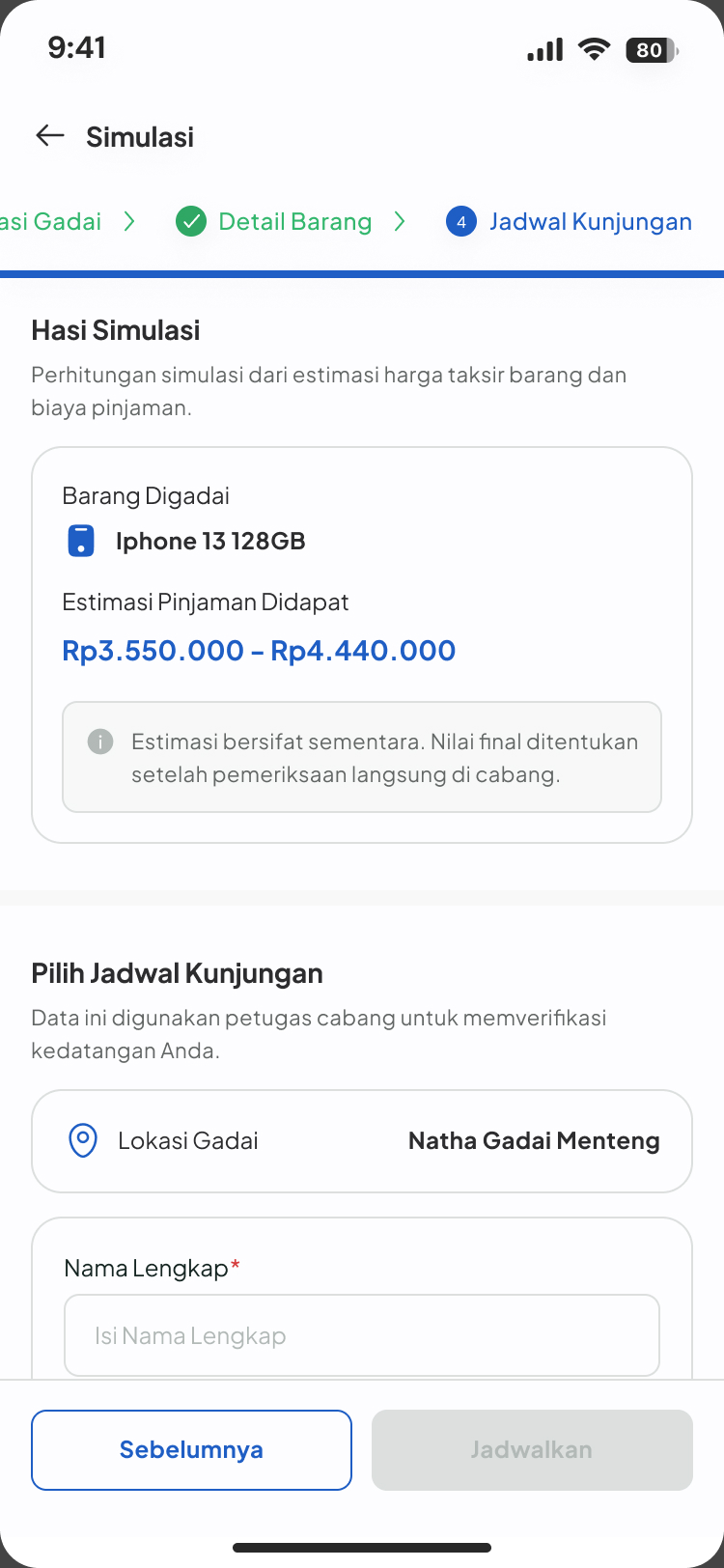
A range, not a single number
The estimate shows a low and a high figure, Rp3.550.000 to Rp4.440.000 for an iPhone 13. A fixed number turns into a promise. If the branch offers less, the customer feels let down, after the trip. A range sets the expectation honestly.
Clear about what it is
A short note right under the range says the estimate is temporary and the final value is set when the item is checked at the branch. The branch has the last word, and the app says so.
From estimate to appointment
The same screen goes on to ask for a name, a WhatsApp number, a day and a time. The estimate turns into a booking without leaving the flow.
With a fixed number
The offer feels like a cutWith a range
The offer lands inside itAround the estimate
A few smaller decisions keep the flow short and the trip certain.
- 01
Start from the item
Six picture cards: gold, phone, laptop, TV, motorbike, car.
- 02
See the nearest branch first
Sorted by distance, with the items each branch takes.
- 03
Describe the item by tapping
Short lists instead of typing, for a more accurate estimate.
- 04
Keep the choices in sight
A four-step bar, and a summary of your item and branch.
- 05
Bring a promo
Pick a voucher or type a code before the trip.
- 06
Find the booking again
On the homepage, and in a list filtered by status.
- 07
A way out
Cancel with a reason, or book again. No-shows become Kadaluwarsa.
The Design
Every journey below plays by itself, straight from the final screens. When one journey ends, the next begins. Pick a journey to watch it, pause to look closer, or jump to any step.
The Ending
In the end, the first trip to the branch stopped being a gamble.
A customer now knows what range they can expect, which branch is closest and takes their item, and when they are expected, all before leaving home. If plans change, the booking can be cancelled and made again in a few taps.
Without Simulasi & Booking
With Simulasi & Booking
The number
Found out at the counter
→
A range, on the phone, before the trip
The branch
Pick one and hope it takes the item
→
Nearest first, with the items it takes
The visit
Turn up and wait
→
A booked day and time, with a code
A pawnshop earns trust before the customer walks in.